Range Repair
Wolf Range Warranty and Parts: What Is Covered, and When
A Wolf range comes with a full two-year warranty that pays for every part and all the labor when something proves defective, measured from its original installation date rather than from your closing date. From year three through year five the coverage shrinks to a short list of components, among them gas burners, electric heating elements and electronic control boards, and the labor becomes your bill. That split matters in Wicker Park and North Center, where a lot of homes change hands after a full rehab and the new owner inherits a range with no idea when its warranty began.
How the two warranty periods divide the cost
The first two years are simple. Any part that fails through a flaw in materials or workmanship under ordinary home use gets replaced, and Wolf pays the technician as well. Once that window closes, limited coverage runs to the fifth anniversary of installation and names specific parts: gas burners (their looks excluded), electric heating elements, hood blower motors, electronic control boards, magnetron tubes and induction generators. Wolf supplies the part; labor and everything else falls to you.
| Time since installation | Parts | Labor |
|---|---|---|
| Years 1–2 | Any defective part | Paid by Wolf |
| Years 3–5 | Listed parts only | Paid by the owner |
| After year 5 | Paid by the owner | Paid by the owner |
Notice what the list leaves out: the igniters and spark modules behind most clicking complaints, the burner valves, the oven temperature sensors and the door hinges. After year two those repairs are yours entirely.
A few more limits catch owners off guard. Cosmetic defects on stainless steel, and on powder-coated doors supplied with the range, are covered for just 60 days, so inspect the finish the week it is uncrated. Filters for a hood recirculating kit are never included. And the whole warranty applies only to a residential install in the fifty states, the District of Columbia or the ten Canadian provinces.
Find the model and serial number before you call
Any warranty claim needs both numbers off the rating plate, the date the range went in and which dealer sold it. Registering the range online or in the owner app keeps those details in one place. If the range came with the house, ask the sellers for the dealer invoice or look through the closing paperwork.
Where the tag sits depends on the range:
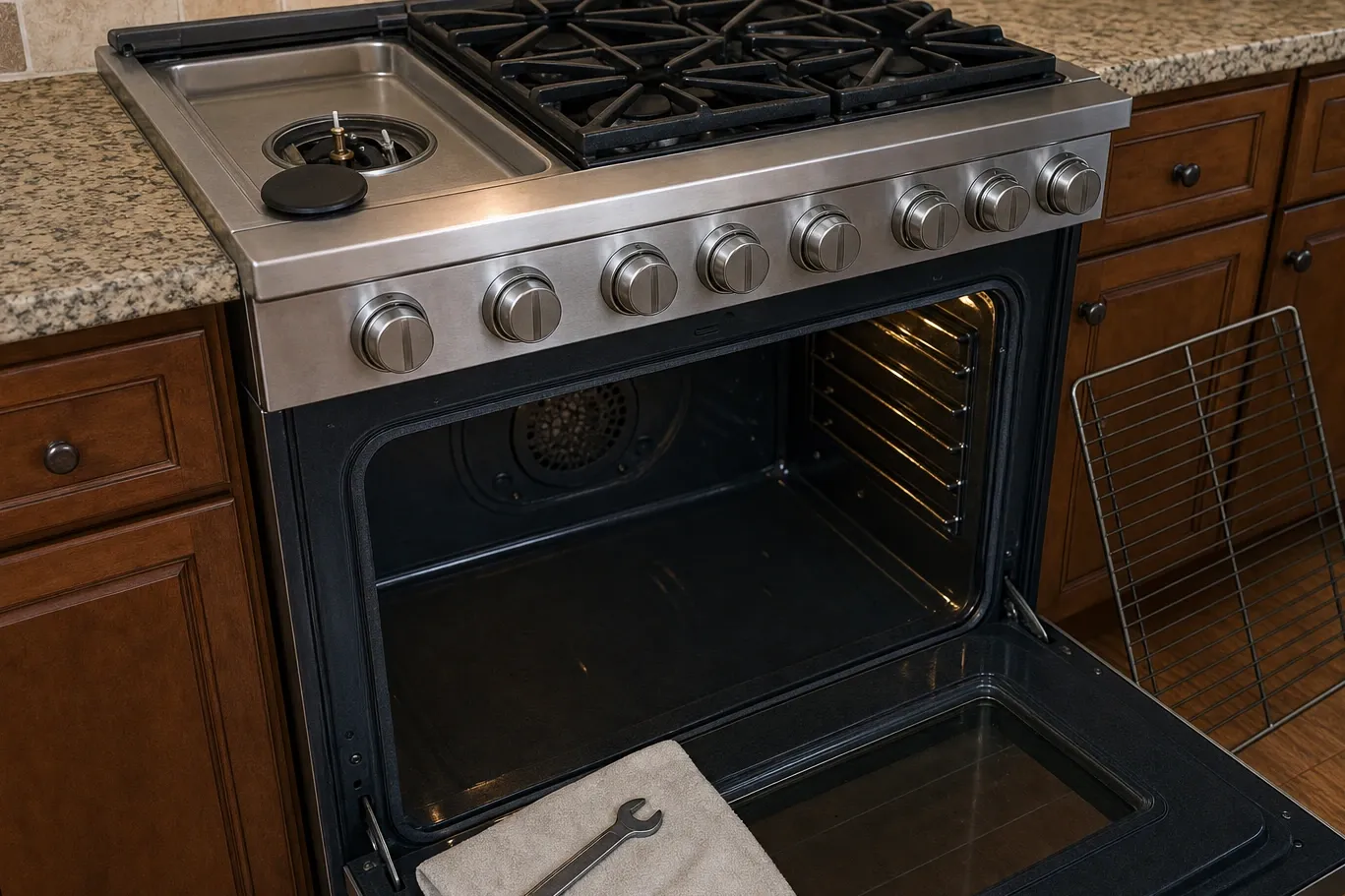
- Today’s dual fuel (DF), gas (GR) and induction (IR) ranges: swing the oven door down, then look along the lower edge of the control panel at its right-hand end.
- SRT sealed burner rangetops: lower edge of the control panel, right-hand end.
- Older R Series ranges and RT Series rangetops: beneath the left-hand burner pan, fixed to the burner box wall.
Unsure which gas range is in your kitchen? A GR has sealed burners, one grate spanning two burners and a stainless push-button light switch, while the older R Series has open burners, a grate for each burner and a black toggle switch. The model number tells you more: DF stands for dual fuel, GR for gas, IR for induction and SRT for a sealed burner rangetop, added letters mark a griddle, charbroiler or French top, and an -LP ending means the range was built for liquid propane.
Genuine Wolf parts or aftermarket
Online sellers list plenty of Wolf range parts, and some aftermarket igniters and knobs look just like the originals. The warranty is where that choice costs money. Wolf does not pay anyone back for parts sourced elsewhere, and during the limited five-year period an owner who hires a service company outside Wolf’s network must contact Wolf to receive the repaired or replacement part. Buy a covered control board yourself and you have paid for something Wolf would have sent at no charge.
Out of warranty the decision is looser, but fit still matters. Appliance makers revise components over a production run, so matching a part to the serial number, not only the model, is the safest way to order. We are an independent service that is not affiliated with Wolf, so in the first two years your first call should go to Wolf itself. After that, we can find the fault and tell you whether the failed part is on the five-year list before anything gets ordered.
Wolf range part numbers worth keeping on file
Wolf publishes numbers for three groups of parts that come up often:
- Anti-tip hardware. Wolf says the anti-tip device should always be installed. The kit for current dual fuel and induction ranges is 829936, and the bolt is 9027407 with washer 6240050. The bracket ships inside the foam wedge of the cavity kit box packed in the oven, which is exactly the box that gets thrown out during a rushed install.
- Gas conversion. On DF3050-DF6050 dual fuel ranges, kit 829533 converts natural gas to LP and kit 829536 converts LP back to natural gas, and Wolf wants a service technician doing the job. On LP only the griddle gives up heat, losing 2,000 Btu. That matters if a range bought secondhand from a propane lake house lands in a Portage Park bungalow.
- High altitude. Kit 829280 exists for natural gas DF3050-DF6050 ranges, though Wolf notes natural gas units rarely need it. Chicago sits at roughly 600 feet above sea level, so a kitchen here has no use for one.
Paying for a repair once coverage ends
Outside the warranty, a visit begins with an $89 service call that covers the trip and a complete diagnosis, and that fee comes off the repair bill once you approve the work. Typical ranges for the jobs a Wolf range needs most:
- Igniter or spark module: $190–$470
- Burner valve or orifice service: $260–$550
- Oven thermostat or sensor calibration: $210–$440
- Convection fan or motor: $280–$600
- Control board or touch panel: $430–$930
- Door hinge, glass or seal: $260–$700
Those are typical bands, and the firm price follows the diagnosis. A comparable new professional range costs $8,260–$18,840, so one failed part rarely justifies replacing the whole thing. If a burner clicks without lighting, start with why one burner clicks forever and never lights, and our Wolf range repair page explains how a visit runs. To book, call (312) 508-4572.
Follow-ups
- How long is the warranty on a Wolf range?
- Two full years on every part and all labor, counted from the date the range was first installed. After that, limited coverage runs to the fifth year on a named list of components, including gas burners, electric heating elements and electronic control boards, and in that stretch the owner pays the labor and any other costs.
- Is a burner that clicks but will not light covered by the Wolf warranty?
- In the first two years it normally is, because a failed igniter or spark module is a defect under the full coverage. The five-year list does not name igniters or spark modules, so later on that repair is yours to fund, typically $190–$470 with the firm figure given after diagnosis.
- Can I buy Wolf range parts online during the warranty?
- You can, but Wolf will not reimburse parts bought from other sources. If a covered part fails in years three to five and an outside service company does the work, the replacement has to come from Wolf, so contact Wolf with your model and serial number before ordering anything.
- Where is the serial number on a Wolf range?
- On current DF dual fuel, GR gas and IR induction ranges, drop the oven door and the plate is on the lower edge of the control panel, toward its right end. On an older R Series range, lift out the left-hand burner pan and you will find it fixed to the burner box wall on that side.
- What does the Wolf warranty leave out?
- Cosmetic flaws on stainless steel and on powder-coated doors supplied with the range are covered for only 60 days, hood recirculating kit filters are excluded, and burner appearance is not part of the five-year coverage. Only residential installs in the fifty states, the District of Columbia or Canada's ten provinces qualify.